Summary: Essential Software Development Skills in 2026
Software development requires both technical and non-technical skills
Skill importance depends on system complexity and organizational context
Enterprise software emphasizes architecture, collaboration, and quality
Continuous learning is essential as platforms and AI evolve
The technology landscape continues to evolve at an unprecedented pace, and with it, the expectations placed on software professionals. While programming languages and frameworks may come and go, certain foundational capabilities separate exceptional developers from the rest. Understanding which software developer skills matter most in 2026 can help professionals and organizations navigate this shifting terrain with confidence.
At Jalasoft, we have spent more than 20 years training, mentoring, and deploying top-tier engineering talent across the Americas. Through this journey, we developed the Jala Framework, a comprehensive approach that identifies the core competencies every successful software professional must cultivate. This framework goes beyond technical checklists to address the full spectrum of what makes developers truly valuable in modern teams.
What Are Essential Skills for Software Development?
Essential skills for software development are the technical, analytical, and collaborative abilities required to design, build, maintain, and scale software systems.
These skills evolve as software shifts from isolated applications to complex platforms integrated with cloud services, enterprise systems, and AI-driven workflows.
Core Categories of Software Development Skills
Software development skills generally fall into four categories:
Technical and programming skills
Problem-solving and system thinking
Collaboration and communication skills
Adaptability and continuous learning
Introducing the Jala Framework for Success
The 6 Essential Skills for Software Development in 2026
The Jala Framework emerged from decades of observation, iteration, and direct feedback from hundreds of client partnerships. Rather than focusing solely on whether a developer can write clean code or configure a cloud environment, this framework recognizes that software development skills encompass a broader set of professional behaviors and attitudes.
The six pillars of the Jala Framework are:
Know Your Domain
Commit
Communicate
Be Accountable
Set Expectations
Be Proactive.
Each of these builds on the others, creating a holistic approach to | that translates across industries, technologies, and team structures.
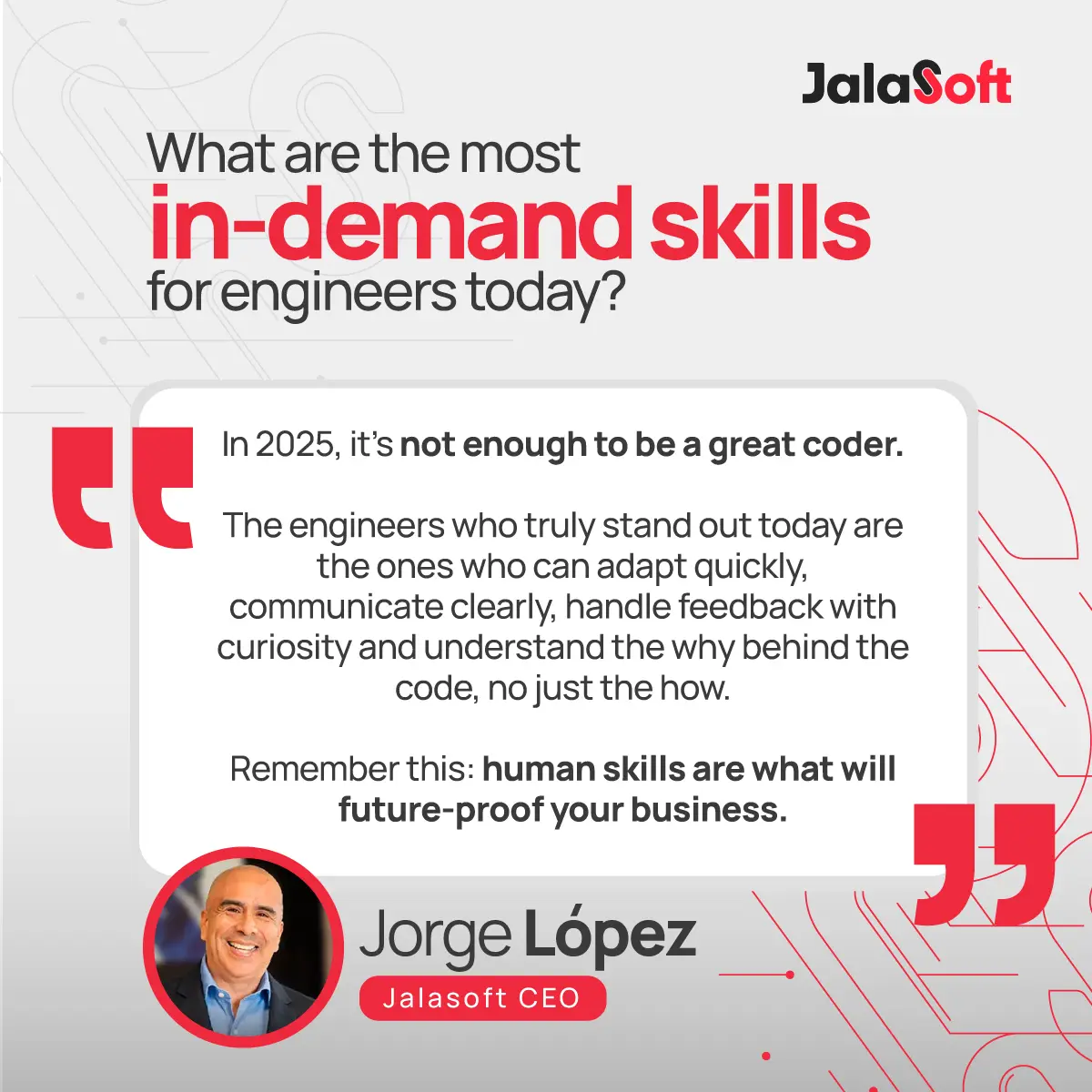
"In 2026, it's not enough to be a great coder", stated Jalasoft's CEO Jorge López, "the engineers that truly stand out today are the ones who can adapt quickly, communicate clearly, handle feedback with curiosity, and understand the why behind the code, not the how."
Explore comprehensive and in-depth strategies related to DevOps practices here. Discover the meaning of DevOps, learn techniques for improving collaboration between development and operations teams, optimize workflows, and more!
Beyond Technical Knowledge: The Soft Skills Gap
One of the most persistent challenges in the software industry is the gap between technical competence and professional effectiveness. A developer might possess encyclopedic knowledge of algorithms and data structures, yet struggle to deliver value within a team setting. This disconnect often stems from underdeveloped soft skills.
Research consistently shows that projects fail more often due to communication breakdowns, unclear requirements, and poor stakeholder management than from purely technical issues. The skills needed for software developer success in 2026 include emotional intelligence, adaptability, and the ability to translate complex technical concepts for non-technical audiences.
At Jala University, our accredited four-year program addresses this gap head-on. Students learn not only the technical foundations of software engineering but also develop the interpersonal capabilities that enable them to integrate seamlessly into client teams from day one.
Why Software Engineer Skills Matter Now More Than Ever
The rise of artificial intelligence, remote-first teams, and accelerating product cycles has intensified the demand for well-rounded software professionals. Companies can no longer afford to hire developers who excel only in isolated coding tasks. They need individuals who can collaborate across time zones, adapt to new tools rapidly, and maintain quality standards under pressure.
This measured approach reflects a broader industry trend: technology alone does not solve problems. The skills needed for software engineer roles must include judgment, strategic thinking, and the wisdom to know when human insight outweighs algorithmic efficiency.
What are the Essential Skills for Software Development
Skill 1: Know Your Domain (Software Development Skills Foundation)
To excel in any endeavor, especially in technology, understanding the domain is paramount. In the software industry, this involves gaining deep and constant knowledge about the product, its value proposition to users, and the surrounding environment. Becoming a specialist requires a meticulous review of all components, their functions, and interactions. This commitment to knowledge positions us as experts in our field.
Programming remains the foundation of software development, but in 2026 it goes beyond syntax. Developers must write code that is readable, testable, and maintainable over long lifecycles.
Building domain expertise requires curiosity and initiative. Developers should actively seek opportunities to shadow business stakeholders, attend industry conferences, and study the competitive landscape of their sector. Organizations partnering withJalasoft's nearshore teams benefit from engineers who prioritize domain learning as part of their onboarding process, enabling faster integration and more meaningful contributions.
What this skill enables:
Translating business requirements into executable logic
Implementing algorithms efficiently
Maintaining large, evolving codebases
Why this skill matters in 2026:
As systems scale and teams grow, poorly designed code becomes technical debt that slows development and increases risk.
Skill 2: Commit (Building Trust and Accountability)
Commitment is the backbone of essential skills for software development. Developers make commitments constantly — during planning sessions, technical discussions, sprint reviews, and informal conversations.
These commitments define expectations and create alignment between teams and stakeholders. Honoring them builds trust and reinforces accountability as a core part of professional ethics.
What this skill enables:
Predictable delivery and reliable execution
Strong working relationships with stakeholders
Reduced friction caused by missed expectations
Why this skill matters in 2026:
In fast-moving, distributed teams, reliability matters as much as speed. Consistent commitment builds confidence across organizations and reduces operational uncertainty.
Skill 3: Communicate (Critical Software Developer Required Skills)
Effective communication is the key to successful collaboration. By regularly communicating progress, identifying risks, and outlining action plans, we reaffirm the expectations set. Over-communication is embraced, ensuring that all team members are on the same page. We value asking the right questions after thorough groundwork, fostering a culture of open dialogue.
Technical skill alone is not enough to build successful software.
What this skill enables:
Translating technical decisions for non-technical stakeholders
Collaborating across roles and teams
Reducing misunderstandings and rework
Why this skill matters in 202:
Distributed teams and cross-functional collaboration make communication a core engineering skill.
Skill 4: Be Accountable (Ownership in Software Projects)
Accountability means taking ownership of outcomes, not just tasks. Being emotionally invested in one’s work creates a chain of trust within the team.
Developers who understand the impact of their decisions on others are more likely to deliver high-quality results and address issues proactively. Accountability transforms teams into dependable units where people can rely on one another.
What this skill enables:
Ownership of outcomes, not just assignments
Faster issue resolution and decision-making
Higher trust within teams
Why this skill matters in 2026:
As systems grow more interconnected, individual decisions can have system-wide effects. Accountability ensures those decisions are made responsibly.
Skill 5: Set Expectations (Software Engineer Skills in Leadership)
Setting clear expectations is the cornerstone of effective project execution. This includes defining how work will be done, what will be delivered, and when results are expected.
In teams where AI tools are part of the workflow—whether for code assistance, testing, analysis, or automation—expectation setting becomes even more critical. Teams must be explicit about how AI is used, where human judgment is required, and what quality standards still apply.
Clear, realistic expectations reduce ambiguity and help teams align priorities. When communicated transparently with clients and stakeholders, expectations build trust and enable smoother transitions throughout a project lifecycle.
What this skill enables:
Clear delivery timelines and scope alignment
Shared understanding of AI-assisted vs. human-owned work
Reduced rework caused by assumptions about automation
Why this skill matters in 2026:
As AI accelerates development speed, unclear expectations can create false confidence. Explicitly defining responsibilities, review processes, and outcomes ensures AI enhances delivery rather than introducing hidden risk.
Skill 6: Be Proactive (Required Skills for Software Developer Success)
Passivity has no place in a culture of excellence. Proactivity means taking initiative, speaking up, and addressing issues before they escalate.
In modern software development, being proactive also means understanding how AI can be used responsibly to improve workflows. Proactive developers explore how AI can assist with analysis, testing, documentation, or prototyping—while recognizing its limitations and validating its outputs.
Rather than waiting for assignments, proactive developers identify opportunities where AI can reduce friction, surface insights, or accelerate learning, and then act on them with ownership and accountability.
What this skill enables:
Early identification of risks and inefficiencies
Smarter use of AI tools to support—not replace—engineering judgment
Continuous improvement of processes and delivery outcomes
Why this skill matters in 2026:
AI rewards initiative. Developers who proactively experiment, validate, and integrate AI into their workflows create disproportionate value, while those who wait risk falling behind as teams move faster.
Successful software development relies on effective collaboration and teamwork. Read this to explore our Nearshore Angular development services, which highlight the importance of multiple developers working together, where communication and cooperation play a vital role.
Technical Skills Required for Software Engineers
While the Jala Framework emphasizes professional behaviors and soft skills, technical competence remains foundational. Modern software engineer skills span multiple technical domains.
Programming Languages and Frameworks
Language proficiency provides the building blocks for all software development work. In 2026, versatile developers maintain familiarity with multiple programming paradigms: object-oriented languages like Java and C#, dynamic languages like Python and JavaScript, and systems languages like Rust and Go.
Framework expertise allows developers to build on proven foundations rather than reinventing solutions. The key insight here is that specific technologies matter less than the ability to learn new ones quickly. A developer with strong fundamentals in computer science, software design patterns, and system architecture can pick up new languages and frameworks as needs evolve.
Version Control and CI/CD
Version control systems like Git have become so fundamental that proficiency is essentially mandatory. Beyond basic commit and merge operations, effective developers understand branching strategies, conflict resolution, and repository management practices that enable team collaboration at scale.
Continuous Integration and Continuous Deployment pipelines represent the infrastructure that transforms code into running software. Understanding how these systems work, including test automation, build processes, and deployment strategies, enables developers to move code from laptop to production with confidence.DevOps practices for better collaboration require developers to think beyond their immediate code changes.
Database Design and Management
Strong database skills include relational modeling, query optimization, indexing strategies, and understanding tradeoffs between SQL and NoSQL systems. Developers should also grasp data migration patterns, backup strategies, and security practices for protecting sensitive information. Cloud-native databases introduce additional considerations around managed services, multi-region replication, and cost optimization.
Cloud Platforms and Infrastructure
Modern developers must understand the major cloud platforms (AWS, Azure, Google Cloud) at least conceptually, with deeper expertise in whichever platform their organization standardizes on. Infrastructure-as-code tools like Terraform enable reproducible, version-controlled deployments. Container technologies provide consistent runtime environments across development, testing, and production. Security considerations permeate all cloud work, including identity management, encryption practices, and compliance requirements.
Soft Skills Needed for Software Developers
Technical prowess alone does not guarantee success. The soft skills needed for software developers complement technical abilities and enable effective collaboration within complex organizations.
Leadership and Mentorship
Leadership in software engineering does not require formal authority. Developers demonstrate leadership by setting technical direction, advocating for best practices, and helping colleagues grow. They take initiative during crises and facilitate difficult conversations. Mentorship multiplies impact: senior developers who invest in growing junior colleagues create value far beyond their individual contributions.
Problem-Solving and Critical Thinking
Software development is fundamentally about solving problems. Strong developers break complex challenges into manageable components, identify root causes rather than surface symptoms, and evaluate potential solutions against multiple criteria. Critical thinking involves questioning assumptions, considering edge cases, and resisting the first plausible answer in favor of thorough analysis.
Time Management and Prioritization
Modern developers face constant demands on their attention: meetings, Slack messages, code reviews, production incidents, and actual coding work. Effective time management means protecting focused work time, batching similar tasks, and ruthlessly prioritizing high-impact activities. Strong developers develop systems for tracking commitments and ensuring nothing falls through the cracks.
Collaboration and Teamwork
Software is built by teams. Even the most talented individual contributor must integrate their work with colleagues' contributions and support shared goals.Agile nearshoring and team dynamics add complexity to collaboration. Distributed teams must develop trust despite limited face-to-face interaction, communicate more explicitly, and invest in relationship-building activities that bridge geographic and cultural distances.
Building Your Skills Development Roadmap
Self-Assessment: Evaluate Your Current Skills
Honest self-assessment provides the foundation for targeted improvement. Developers should evaluate themselves against the software development skills outlined above, identifying both strengths to leverage and gaps to address. Feedback from managers, peers, and mentors adds valuable external perspective.
Continuous Learning and Professional Development
The technology industry evolves too quickly for static skill sets. Successful developers embrace lifelong learning through courses, conferences, books, podcasts, and hands-on experimentation. Effective learning balances depth in a specialization with broad familiarity across adjacent domains.
Mentorship and Knowledge Sharing
Learning accelerates when shared. Developers who teach others reinforce their own understanding while building professional networks and reputations. Teaching takes many forms: formal presentations, blog posts, open-source contributions, and informal knowledge sharing within teams.
Industry Certifications and Specializations
Certifications validate knowledge and signal commitment to professional development. While not substitutes for practical experience, credentials from major cloud providers and security organizations can differentiate candidates and open doors to new opportunities. Deep specializations in areas like machine learning or cybersecurity create unique value that generalists cannot easily replicate.
The Jalasoft Approach to Developer Excellence
The Jala Framework in Practice
The six skills of the Jala Framework form the backbone of how Jalasoft engineers engage with client projects. From initial onboarding through long-term collaboration, these principles guide professional conduct. Our engineers invest time in understanding client domains before diving into code. They communicate transparently about progress and challenges. They take ownership of outcomes rather than merely completing assigned tasks.
How We Build and Train Engineering Talent
Jalasoft's approach to talent development differs fundamentally from traditional recruiting. Rather than competing for scarce senior talent, we invest in identifying high-potential individuals and developing them through rigorous training programs.
Jala University represents this commitment made manifest. Our four-year accredited program accepts only the top applicants, training them in both technical skills and professional behaviors under the mentorship of Jalasoft's senior engineers. Graduates emerge prepared for real-world challenges from day one.
Success Stories: Skills That Drive Client Success
Our 20+ years of client partnerships demonstrate the value of this holistic approach. Clients consistently report that Jalasoft engineers integrate seamlessly with their teams, understand business contexts quickly, and contribute meaningfully beyond narrow technical tasks. These outcomes flow directly from our systematic investment in the complete developer skill set.
20+ Years of Developing Top-Tier Software Engineers
Since our founding, Jalasoft has helped hundreds of organizations build and scale their engineering capabilities. Our presence across 12 countries, team of over 1,000 engineers, and ISO 27001 certification reflect our commitment to excellence and security.
Get in touch with our experts today to explore how Jalasoft can help you build the engineering team your organization needs or to discuss opportunities to join our growing community of elite software professionals.


